
Olmsted County Release Records
A person is released from Olmsted County custody when the Adult Detention Center ends that booking or transfers the person to another authority. Those outcomes are not equal. Bail, recognizance, time served, a court order, and sentence completion can lead back to the community. A transfer to the Minnesota Department of Corrections, another county, the United States Marshals Service, or another facility ends the local booking but may begin or continue custody elsewhere. The Sheriff record should state which event occurred.
Released Olmsted County inmates normally disappear from the live jail list. That change is only a lead. It does not prove when the door-out process ended, why the person left, or whether another agency received them. The originating release or transfer data is the best local evidence. A district-court case can then explain the bond, sentence, dismissal, or commitment behind the event. For a prison or federal release, the Minnesota DOC or Bureau of Prisons holds the more relevant record.
A missing name on the current-custody list does not establish community release. Check the release or transfer record and the receiving system.
Olmsted County Release Paths
Release language should be read with the legal basis and the next agency. “Released” may describe freedom from one booking, not freedom from all custody or correctional control. Olmsted County records can separate a release from a custody transfer, while court and corrections records explain what follows.
| Event | What it means | Best next record |
|---|---|---|
| Bail or recognizance | ADC processing ends after the required court or bail steps. | Sheriff release data and the Olmsted court case |
| Time served or sentence completion | The local jail term is credited or complete. | ADC timestamp and sentencing register |
| Dismissal or court order | The case may no longer support that hold, though another hold can remain. | Court disposition plus ADC release or transfer data |
| DOC or agency transfer | The county booking ends because another authority receives the person. | Transfer recipient and that agency's locator |
| Prison supervised release | Prison confinement ends while Minnesota DOC jurisdiction continues. | Minnesota DOC status and maintained release fields |
- Discharge
- The end of a sentence or correctional jurisdiction, not merely the end of confinement.
- Supervised release
- The community portion of many Minnesota prison sentences.
- Probation
- Court-ordered community supervision, often instead of an executed prison term.
- Detainer
- A hold or request from another authority that can prevent community release.
Fields in Olmsted Release Records
Minnesota Statutes section 13.82 gives the local record unusual precision. Subdivision 2 makes adult arrest data public at the originating law-enforcement agency. Clauses (h) and (i) cover the date, time, and legal basis of a custody transfer or release, plus the receiving agency for a transfer. That detail prevents a transfer to state prison from being mistaken for a return to the community.
| Field | What it establishes |
|---|---|
| Name and booking identifier | Connects the event to the correct ADC booking. |
| Booking date and time | Marks the start of the local custody episode. |
| Release date and time | Records when release from that custody was processed. |
| Legal basis | States the maintained reason, such as a qualifying order or sentence event. |
| Transfer date and time | Distinguishes transfer from community release. |
| Receiving agency | Names the authority to search next. |
| Booking photograph and photo date | Links an agency image to its booking context. |
The exact county labels may vary, so a request should ask for existing fields instead of assuming a menu of release reasons. Court records remain useful, but an order time may precede ADC processing. VINELink can report an agency-fed event, yet it is not a certified historical record. No official online retention period was found for Olmsted County released inmates because the county does not publish a released-person archive.
Request Olmsted County Release Data
The Olmsted County Data Practice Request is the durable path after a name leaves the jail list. Ask for maintained data, not an explanation that the agency would need to create. Include enough identity and booking detail to prevent a same-name match. Public inspection is free. For up to 100 black-and-white letter or legal pages, state law caps copy charges at 25 cents per page; other permitted copy and retrieval costs can apply.
- Give the adult's full name, date of birth, approximate booking interval, and booking number if known.
- Request the booking record; release date, time, and legal basis; and any transfer date, time, recipient, and basis.
- Ask for the booking photograph and photo date under subdivision 26 when that record is needed.
- Request electronic copies as maintained, and ask for an estimate before costs are incurred.
- If data is withheld, ask for the exact statutory classification and a written denial.
Olmsted County may charge actual permitted costs for some work, and its policy allows prepayment when a request takes more than four hours. The stated ten-business-day route applies to a person requesting data about themself, with identity rules. An ordinary public request instead uses the statutory prompt or reasonable-time standard. Government need not create a new release list if one is not maintained.
County Data Practices Compliance OfficialLisa Morris-Helmstetler, Administration
151 Fourth Street SE
Rochester, MN 55904
507-328-6012
lisa.morris-helmstetler@olmstedcounty.gov
Olmsted Release Law and Sealing
Minnesota Statutes chapter 13 presumes government data public unless another law classifies it otherwise. Section 13.03 provides inspection rights, permits limited copy charges, and requires an agency to cite the classification used for a denial. Section 13.82 makes the core adult release and transfer fields public. It also makes booking photographs public, subject to temporary withholding when access would harm an active investigation.
Public status does not force a permanent online gallery. Juvenile data and active investigative material can follow different rules. Expungement under chapter 609A may also make an older public court result unavailable. Sealing usually does not mean physical destruction, and a no-result does not prove that no arrest or release occurred. The county release timestamp and the court's disposition serve different roles, so each should be obtained from its own record custodian.
When Olmsted Bail Starts Release
Olmsted's official bail instructions show why payment and actual release are distinct. During court business hours, payment occurs at Court Administration. The receipt must then reach ADC before jail processing begins. Outside those hours, the payer uses the lobby wall phone by the ADC circle drive and follows the facility payment process. The jail cannot make change.
A court entry or receipt can prove authority and payment, but neither supplies the door-out time. The ADC release record does. Another hold may also delay or prevent community release after the case that prompted the payment is resolved. This local two-step process is a strong reason to compare the judicial record with the Sheriff's maintained timestamp.
Olmsted County Jail Release Time
The Sheriff publishes no fixed daily release clock. Business-hour and nonbusiness-hour bail workflows show that processing can begin in more than one time window, including holidays, but the county does not promise a set completion time. Its instructions warn that processing can be lengthy. A person waiting for an Olmsted County release should rely on ADC confirmation instead of estimating an exit from the time a bond was paid or an order was filed.
Note: The weekday court-payment window describes where bail is paid, not the hours during which every jail release can occur.
Rides After Olmsted County Release
Family or friends do not need to remain through a long release wait. The ADC instructions say the released person can use a facility phone to call for a ride. A driver who claims responsibility for the person's care must pass a breath test showing sobriety. No official transit-stop, taxi, or rideshare rule was found, so those details should not be assumed. The safe plan is to keep contact information available and follow current ADC directions.
Olmsted Pretrial Release Decisions
Dodge and Olmsted Pretrial Services uses an individualized, validated assessment and provides a recommendation when release is considered. The program began in 2019 and received a National Association of Counties award in 2021. A recommendation is not itself a release record or court order.
The Sheriff's 2024 report counted 1,458 recognizance-release events and 492 bail events. Those operational categories help explain how local release is managed, but they are not a deduplicated list of people. The court order states the legal terms. ADC data states when the jail event occurred. Use both when the difference matters.
Olmsted County Release Activity
The 2024 Sheriff annual report gives local operating context without serving as a person-level search. ADC recorded 3,962 bookings and an average daily population of 121.42. The Work Release Facility reported 140 releases. Court activity also separated recognizance, bail, sentenced or held, and out-of-county events. These figures must not be added together and called unique releases because the report does not define them as mutually exclusive people.
Find Olmsted County Released Inmates
Start with the system that held the person. Olmsted County has no official released-person archive and no rolling release feed. The live roster can show that a person remains in ADC at the time represented, but absence cannot prove release. For a named local booking, the most reliable sequence pairs the Sheriff's release or transfer fields with the Olmsted court case.
- Check the official current-custody page. Treat it only as a current list.
- If the person is absent, call ADC at 507-328-6790 and request the release or transfer record under section 13.82.
- Search Minnesota Court Records Online for the Olmsted case, then compare identity, bond, sentence, and disposition.
- If the record names a DOC transfer or prison term, search the Minnesota DOC locator by name or six-digit offender ID.
- For federal custody, use BOP. Use VINELink as a notification and event source, then confirm through the originating agency.
A warrant hit is separate from release proof. So is a court dismissal when another hold may exist. Use at least two identity points for common names, such as date of birth, booking number, offender ID, case number, alias, or photo date. The Olmsted 24-hour release alternatives explain how to define a same-day request when no feed exists.
Minnesota DOC Olmsted Release Search
The Minnesota DOC public locator covers adults committed to the Commissioner who remain under DOC jurisdiction. Search by first and last name or all six digits of the MNDOC Offender ID. Name searches use prefixes and can include DOC name history and conviction-linked aliases. Newly sentenced people may take several business days to appear, and a fully discharged person may later fall outside the locator's scope.
| Search or result field | How to use it |
|---|---|
| Name | Use first and last name, then check aliases. |
| MNDOC Offender ID | Enter all six digits for the strongest direct search. |
| Birth date | Compare it before opening a same-name record. |
| Current Status | Distinguish an institution from “Under Supervision.” |
| Anticipated Release Date | Read as a future operational estimate, not a completed event. |
| Agent and expiration | Use for post-prison supervision, not as the actual release date. |
A released profile can say “Under Supervision as of” or “Under Intensive Supervised Release as of,” name Olmsted D&O, identify an agent, and show an expiration date. Read the whole status because it may also mention custody at a non-DOC facility. For durable history, DOC Records Management can provide Actual Release Date, Confinement Release Date, release status, termination, and public conditions-of-release data.
The official Minnesota DOC offender search screen shows the name and offender-ID entry points used for an Olmsted County prison-release check.
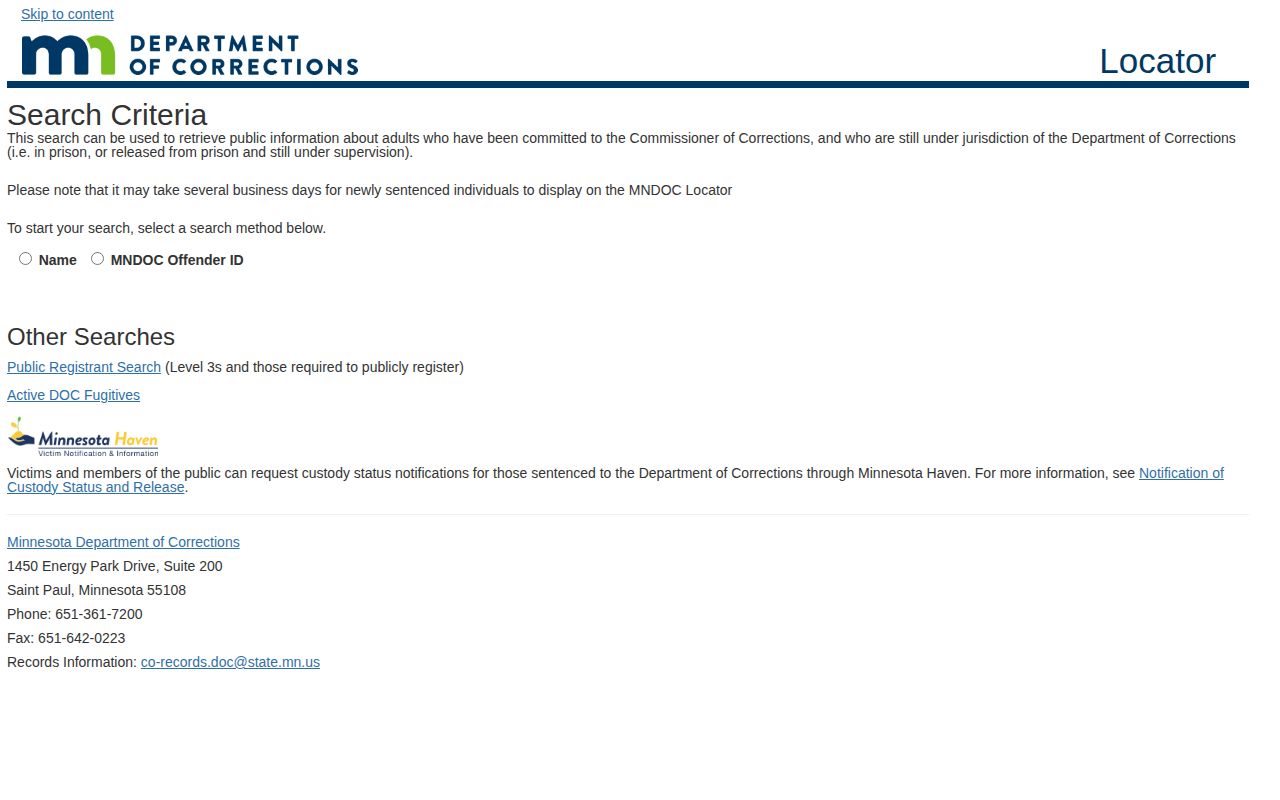
This screen belongs to the state-prison system. It does not cover an ADC-only detainee who was never committed to Minnesota DOC.
Olmsted Release Supervision Records
Dodge and Olmsted Community Corrections is the local follow-up when a DOC profile names “Olmsted (D&O Community Corrections) (CCA).” The joint county department handles probation, pretrial services, intensive supervised release, electronic monitoring, treatment court, and lower-level telephone or web reporting. These programs are distinct, and its service list does not prove that every person participates in each one.
Minnesota has no complete public statewide probation lookup. For a released state prisoner, begin with the public DOC profile and contact the named agency when public verification needs clarification. Ordinary modern Minnesota prison sentences usually move from confinement to supervised release without a discretionary parole hearing. A Supervised Release Board now serves limited statutory groups, including some life or indeterminate and juvenile-offense cases. The Olmsted probation and parole record path explains that distinction and the local warrant check.
Olmsted Recent Release Limits
Olmsted County publishes current custody, not recent releases. The live application says it shows who is in jail on a given day and is updated daily. It displays booking information and photographs, but it has no release-date field, released tab, 24-hour window, 72-hour window, or stated period for keeping a person visible after release. The temporary-issue screen observed on July 24, 2026 had cleared when the application was rechecked on July 26.
Restored access does not turn the roster into a release feed. The county wrapper, ADC phone, court search, and Data Practice Request remain the formal release fallbacks. A date-bounded request may seek existing public release entries for exact Central Time boundaries. The county need not build a custom list if it does not maintain one.
Olmsted Release Alerts and Federal Records
Minnesota VINELink can search a specific person and provide available phone, text, email, or app notifications. Choose Minnesota, compare all displayed identifiers, open the matching record, and select an offered custody or release event. Coverage comes from participating agency feeds, and no source proved that every Olmsted booking stream is included. A delayed or missing event must be checked with ADC or DOC.
Federal Medical Center Rochester uses the BOP Inmate Locator, not the county roster or Minnesota DOC. A past release date with “RELEASED” means the person is no longer in BOP custody. It does not end federal supervision or rule out state, county, or immigration custody. ICE has its own detainee locator, while the United States Marshals Service has no comparable general released-person search. Use the federal court and actual holding facility for a pretrial release.
Compare Olmsted Release Sources
The correct source depends on both the custodian and the question. Current custody, a completed release, a prison-to-supervision transition, and a federal release belong to different records.
| Source | Best use | Key limit |
|---|---|---|
| Olmsted current list | Check whether a person is shown in ADC now. | Absence is not release proof. |
| Sheriff release or transfer data | Confirm local date, time, basis, and recipient. | Must often be requested. |
| MCRO | Explain the court order, bond, sentence, or disposition. | Does not give the ADC door-out time. |
| Minnesota DOC | Check prison status, anticipated date, or supervision. | Does not cover ADC-only custody. |
| VINELink | Receive an agency-fed event or alert. | Not a certified history. |
| BOP | Confirm the end of federal BOP custody. | Does not resolve other custody or supervision. |
Olmsted County Release Facilities
The Olmsted County Adult Detention Center is the main local jail. It opened in 1993 with 100 beds and later expanded to a rated 202. It can hold pretrial and sentenced people plus boarders. A departure may be community release or transfer, so ADC data and the named receiving agency control the search.
The Olmsted County Work Release Facility opened in 2003. A participant who leaves for verified work remains in structured custody and has not been finally discharged. Court-ordered eligibility and the jail record should be read together. Federal Medical Center Rochester is a BOP medical prison. Its release record follows the BOP locator and federal court system, not the Olmsted jail roster.
- Olmsted County Adult Detention Center: county release or transfer data.
- Olmsted County Work Release Facility: work movement versus final discharge.
- Federal Medical Center Rochester: BOP release status and date.