
Olmsted Release Date Labels
The Minnesota DOC public locator uses the exact label Anticipated Release Date for an incarcerated person. The Supervised Release Board may assign a projected release date in a covered board review. DOC records can separately contain Actual Release Date, Confinement Release Date, Termination Date, Expiration Date, and a date when supervision began. These labels answer different questions.
An anticipated or projected date looks forward. Actual Release Date records an event. Confinement release can mark the end of the prison portion, while sentence expiration or termination may occur later. A supervision profile can also note custody in another facility. Keep each source's wording when recording the date rather than calling every field “release date.”
- Anticipated Release Date
- The operational future date displayed in the DOC public locator.
- Projected release date
- A conditional date the Supervised Release Board may assign in an eligible case.
- Confinement release
- The transition from the prison portion of a sentence, not necessarily final sentence discharge.
- Detainer
- Another authority's request or legal basis to hold or receive the person.
Find an Olmsted Release Date
Start with the sentence and facility. The Olmsted County Adult Detention Center holds pretrial detainees, locally sentenced people, boarders, and people awaiting transfer. Minnesota DOC holds people committed to the Commissioner. Federal Medical Center Rochester belongs to BOP. A date from one system should not be applied to another.
- Check the Olmsted court case in Minnesota Court Records Online for judgment, sentence, jail credit, stay, bond, or commitment language.
- If the person was committed to Minnesota DOC, search the DOC public locator by name or all six MNDOC ID digits.
- Confirm name, birth date, aliases, OID, current status, and court-file number before reading the Anticipated Release Date.
- For an ADC-only sentence, request the local sentencing register and existing jail release or transfer data. Do not import the prison formula.
- For a Board-eligible case, check the current Board schedule, agenda, and approved minutes, then confirm the status with DOC.
- After the event, request Actual Release Date or Confinement Release Date when formal historical proof is needed.
The general Olmsted County released inmate search covers the sheriff timestamp and court-disposition evidence needed after a date has passed.
Note: A court order can authorize release before the ADC completes physical processing or resolves another hold.
Olmsted DOC Anticipated Release Date
The Minnesota DOC locator covers adults committed to the Commissioner who remain under DOC jurisdiction. A name search is prefix based and includes DOC name history and conviction-associated aliases. Newly sentenced people may take several business days to appear. Search results show name, birth date, known aliases, MNDOC Offender ID, and current status before the detail page is opened.
The DOC profile example with an Anticipated Release Date shows how the field appears in context:
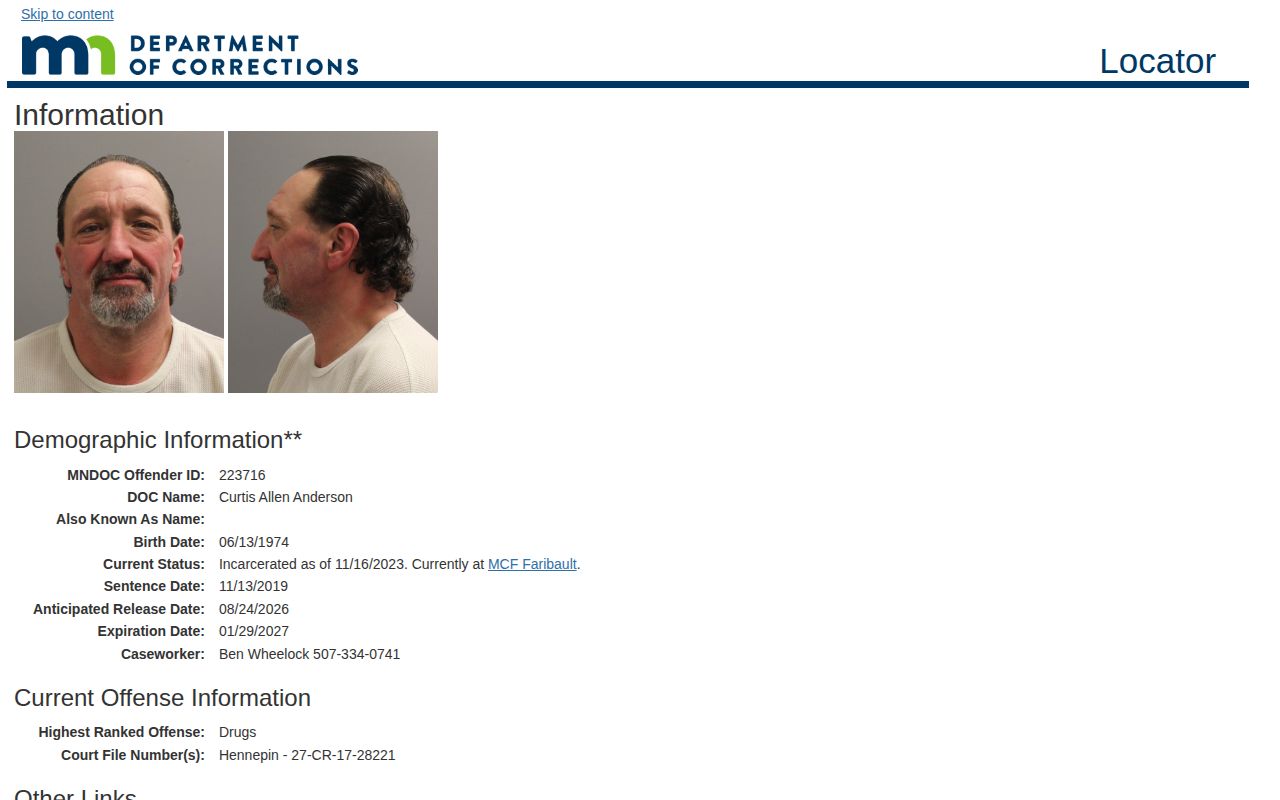
The surrounding record matters as much as the date. Current status, facility, sentence date, offense, court file, and identity fields help prevent a date from being attached to the wrong person. A photograph may be displayed, but it should not override conflicting identifiers.
Olmsted Minnesota Sentence Structure
Minnesota is not an ordinary “serve 85 percent” state. For ordinary crimes committed on or after August 1, 1993, Minnesota Statutes §§244.01 and 244.05 generally divide the executed sentence into two-thirds imprisonment and one-third supervised release. Disciplinary confinement and specialized statutes can change how that structure applies. The supervised portion remains part of the sentence.
This rule does not let a reader calculate a reliable individual date from the sentence length alone. Jail credit, amended sentences, disciplinary action, specialized offense statutes, treatment-based programs, detainers, and administrative records can alter the operational date. Use the DOC date displayed for that person at that time. Then use the actual release record after the event.
Note: The ordinary two-thirds rule applies to state imprisonment, not an Olmsted County ADC sentence by analogy.
Olmsted Earned Release Credits
Legacy good time and modern earned incentive release credit are separate systems. Crimes before August 1, 1993 may fall under the older good-time provisions in §§244.01 and 244.04. The modern earned-incentive framework appears in §§244.41, 244.44, and 244.45. It uses individualized rehabilitation objectives rather than a simple daily deduction that the public can apply from a sentence line.
Section 244.44 permits up to 17 percent of the total executed sentence in earned incentive release credit. It cannot reduce imprisonment below one-half of the executed sentence, and it does not shorten the total supervised-release term. Section 244.45 excludes life sentences, certain pre-1980 indeterminate cases, and legacy-good-time cases. Eligibility, earning, loss, and the person's current DOC computation still have to be checked in the official record.
Changes to Olmsted Release Dates
A date can move for reasons found in the sentence, prison record, or another agency's hold. Some factors change the confinement calculation. Others leave the calculated date intact but prevent release to the community. The source should say which event occurred.
| Factor | Possible effect | Record to check |
|---|---|---|
| Disciplinary confinement | Can extend the prison portion | DOC computation and discipline record |
| Earned incentive credit | Can advance release within statutory limits | DOC release calculation |
| Jail or custody credit | Can alter time remaining | Court judgment and DOC computation |
| Amended sentence or court order | Can change the controlling term | MCRO register and filed order |
| Detainer or transfer | Can move the person to another custodian | ADC transfer data or named agency |
| Board continuance or decision | Can delay or condition a board-eligible release | Board minutes and DOC status |
| Consecutive sentence | Can keep a person confined after a grant | Sentence records and DOC status |
A grant is not always a physical release. The Supervised Release Board's 2025 report recorded grants in which consecutive sentences still kept people incarcerated. The same caution applies to an ADC transfer: leaving the county roster may mean movement into state or federal custody.
Olmsted Weekend Release Rules
Minnesota has a distinctive calendar rule in §244.05, subdivision 1a. For certain crimes committed before August 1, 1992, a Friday, weekend, or holiday release is moved to the preceding qualifying weekday. For covered later crimes, release is moved to the first later day that is not Friday, a weekend, or a holiday. The offense date and statutory coverage matter, so the rule should not be applied without the DOC record.
The calendar provision concerns a state-prison release. It is not proof of a fixed Olmsted ADC release schedule. The county publishes no fixed release clock, and the bail page only documents business-hour and nonbusiness-hour payment workflows. Administrative processing or another hold can separate payment from physical departure.
Olmsted County Jail Release Dates
A pretrial detainee usually has no sentence-derived projected date. Bail, recognizance, a court order, dismissal, or another hold can control the next event. During court business hours, bail may be paid through Court Administration and the receipt then taken to ADC to start processing. Outside those hours, the ADC lobby process applies. Neither workflow supplies a guaranteed door-out time.
For a locally sentenced person, read the sentence term, jail credit, and later court entries. Then ask the Sheriff's Office for existing data showing date, time, and legal basis of release or the date, time, basis, and receiving agency for a transfer under Minnesota Statutes §13.82, subdivision 2. A transfer to DOC is not community release. A temporary work-release departure is still structured custody.
No separate published Olmsted jail good-time formula was found. That absence prevents a sound date estimate based only on the term imposed. The sentencing register may show jail credit or a later amendment, while ADC data records what the facility actually did. If the current list drops the name, request release or transfer fields rather than treating roster absence as the computed date.
Note: Olmsted publishes current custody, not an online projected-date field for ADC detainees.
Olmsted Board Projected Release
The Minnesota DOC Supervised Release Board applies only to limited statutory categories. Its initial readiness review can occur before eligibility. The Board may assign a projected release date or continue the matter with directives, but it cannot release someone before the legal eligibility point. Ordinary modern determinate cases do not receive this discretionary hearing process.
Use the Board schedule, agenda, approved minutes, and annual report to identify the decision. Then check DOC current status and maintained actual-release fields. Meeting materials can age off the public schedule, and no standalone searchable decision database was found. A records request is the durable fallback for an older outcome.
Confirm Olmsted Actual Release
After the anticipated date passes, look for the system-specific event. A DOC profile may change to “Under Supervision as of” and name an Olmsted D&O agency, agent, and expiration date. That is strong public evidence of a prison-to-supervision transition, though the full status can still mention custody elsewhere. Fully discharged people may fall outside locator scope.
Request DOC Records Management fields when a lasting record matters: Actual Release Date, Confinement Release Date, Release Status, Termination or Expiration Date, public conditions-of-release fields, and supervising agency. For a county jail event, request the ADC release or transfer record. A VINELink notice can supplement those sources, and the Olmsted VINELink inmate search explains prospective alerts, but VINE is not the certified history.
Board and locator dates also need separate treatment. A Board projected release date records a conditional decision for an eligible case. The locator's Anticipated Release Date is DOC's operational estimate for an incarcerated record. Neither field is the maintained Actual Release Date. If a Board grant coexists with a consecutive sentence, the person may remain confined. Compare the decision, current DOC status, sentence records, and actual-release fields before stating that the Olmsted County person entered the community.
Note: Anticipated release, confinement release, supervision start, expiration, and discharge should remain separate in any date comparison.