
ADC Release Paths
The Olmsted County Adult Detention Center holds several groups under one roof. They include people awaiting court action, people serving local sentences, boarders held for other governments, and work-release participants. That mix makes the word “release” less simple than it sounds. Bail, recognizance, a court order, completion of a local jail term, and removal of a hold can lead to the community. A state commitment, another county’s warrant, or a federal matter can instead lead to a transfer. In that case, ADC custody ends while custody elsewhere begins.
The most useful county record states the date and time of the event, its legal basis, and whether another agency received the person. Minnesota Statutes §13.82, subdivision 2(h) covers transfer data, including the receiving agency. Subdivision 2(i) covers the date, time, and legal basis for release. Those fields are more reliable than assuming that a name missing from the jail list means the person is free in Rochester.
| ADC outcome | Best next source |
|---|---|
| Bail or recognizance | ADC release data plus the Olmsted County court case |
| Local sentence completed | ADC release timestamp and the sentencing record |
| Minnesota DOC transfer | ADC transfer data and the Minnesota DOC locator |
| Other agency transfer | The named receiving agency and related court record |
Confirm an ADC Release
Start with the official Olmsted County “Who Is in Custody?” page. It is a current-custody route, not a released-person archive. The archived application described a list updated daily and showed booking details, charges, status terms, and photographs for current detainees. It did not show a release date, a release reason, or a recent-releases tab. A missing name is therefore a clue, not proof of an ADC release.
Use a source chain that matches the case. The Olmsted County released-inmate search and records overview explains how county, state, court, and federal records fit together. For an ADC event, the Sheriff’s record remains the key source for the actual jail action.
- Match the person by full name, date of birth, booking number, or court file number. Similar names can lead to the wrong record.
- Check the current custody list. If the person is still listed, the screen does not show a completed ADC release at that time.
- Call ADC at 507-328-6790 for current information. Ask whether the person was released or transferred, without treating a phone answer as the maintained record.
- Request existing Sheriff data showing release or transfer date, time, legal basis, and receiving agency. Ask for electronic copies if the data are kept electronically.
- Review the Olmsted County District Court case in Minnesota Court Records Online. Court entries explain the order, sentence, bail, or disposition, but may not show the moment ADC processing ended.
ADC Release Records and Contacts
The Sheriff’s Adult Detention Center handles the facility event. Olmsted County’s Data Practices route handles requests for maintained county data. A narrow request should identify the adult, the approximate booking period, and the booking number when known. Ask for existing fields rather than an explanation created for the request. Useful fields include the booking record, release date and time, legal basis, transfer date and time, and receiving agency.
Submit through the Olmsted County Data Practice Request portal or use the county’s listed mail, fax, or email options. Inspection is free. Copy charges follow Minnesota Statutes §13.03 and the county policy. The county need not build a new report that it does not keep, so a request for one person and one booking is often more direct than asking for an undefined release list.
Adult Detention Center
101 Fourth Street SE
Rochester, MN 55904-3719
Phone: 507-328-6790
Fax: 507-328-6833
Administration: 507-328-6837
Operations: 507-328-6834
Record wording: Request “existing public data showing the date, time, and legal basis for release, or the date, time, legal basis, and receiving agency for a transfer.” If data are withheld, ask for the statutory classification and a written denial. General public requests use the prompt or reasonable-time standard. The county’s separate ten-business-day language concerns its data-subject process and should not be treated as a promise for every request.
Note: The ADC telephone line can clarify current status, while the maintained Sheriff record documents the completed release or transfer event.
Inside Olmsted County ADC
The official ADC description places the maximum-security facility in the Olmsted County Government Center. The Sheriff is responsible for adult detention and court security. ADC uses direct supervision, a model in which detention deputies work within living units and stay in direct contact with detainees. The county describes a male and female population that can include pre-sentenced detainees, sentenced detainees, boarders, and people approved for work release.
The same county source documents education, recreation, religious programs, adult basic education and GED teaching, counseling, library access, contracted health care, and a mental-health team. These facts describe the facility and its services. They do not show whether a named person has been released. Person-specific proof still comes from the current list, a release or transfer record, and the related court or receiving-agency record.
ADC History and Release Context
Olmsted County opened ADC in 1993 with 100 beds and later expanded it to a rated 202 beds. That growth is part of the local custody story. The facility can house county detainees as well as boarders for federal, state, and other county agencies when space is available. A person’s physical location at ADC therefore does not always reveal which government controls the next step.
The county opened the Work Release Facility in 2003 as a named ADC component. Its existence also explains why seeing someone leave for approved work is not enough to report a final release. Work-release participants remain in structured custody and return to the facility. Final discharge must be tied to ADC data and the sentencing case, not to a daily departure.
The official facility capture below shows the county source used for ADC history, capacity, and operating context. Review the Olmsted County ADC profile before relying on a facility detail that may change.
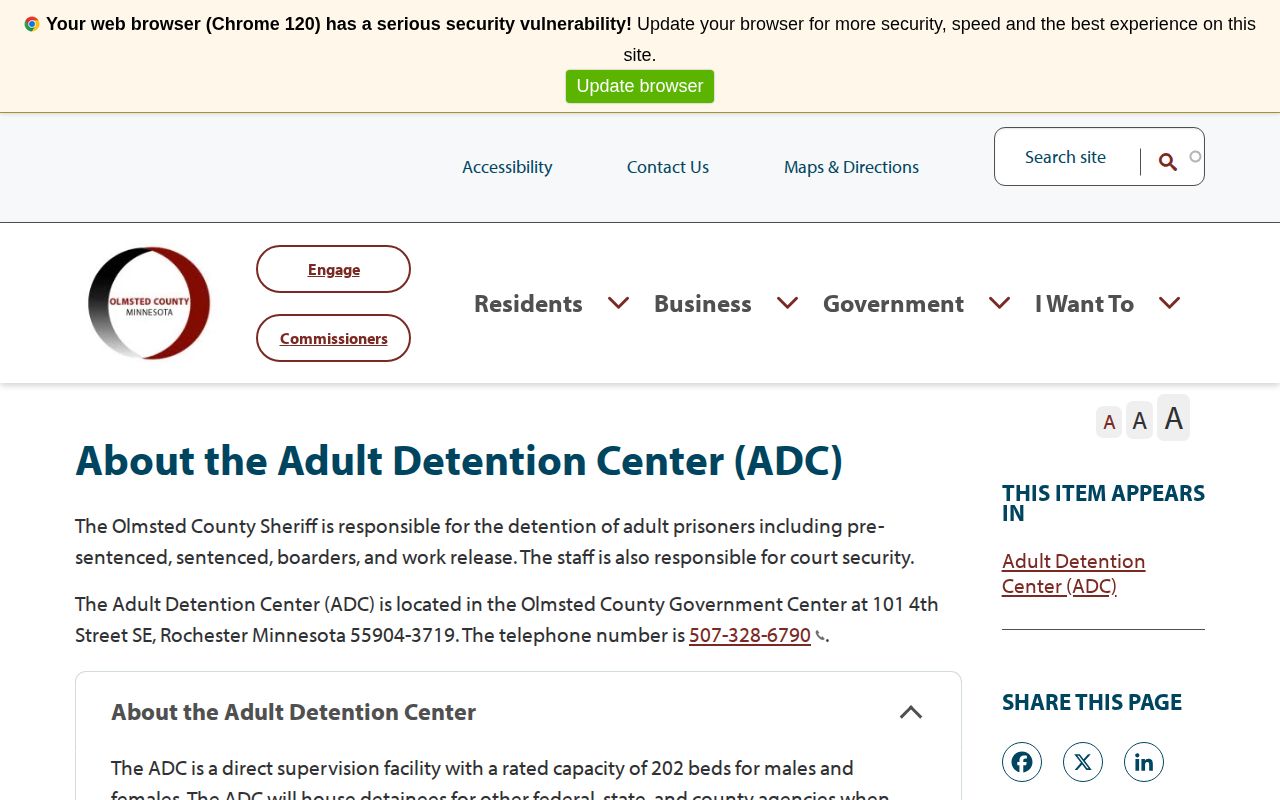
The image supports the facility profile, while a named person’s release still requires the separate record path described above.
Transfers After ADC Release
A transfer is the point where source discipline matters most. If ADC reports an “MN DOC Hold” or names the Minnesota Department of Corrections as recipient, search the Minnesota DOC public locator by name or all six digits of the MNDOC Offender ID. Newly committed people may take several business days to appear. A later DOC institution profile supports transfer into state custody. A status such as “Under Supervision as of” concerns a later prison-to-supervision change and should not be used as the ADC door-out time.
If another county or a federal agency received the person, follow the agency named in the subdivision 2(h) transfer data. ADC’s authority to board federal detainees does not prove that it has a current ICE detention contract. No such contract was verified in the research. For a BOP prisoner, use the BOP locator. For a federal pretrial matter handled by the U.S. Marshals Service, use the federal court record and the actual holding facility because USMS offers no comparable public released-person locator.
Note: A receiving-agency name changes the search route and prevents an ADC transfer from being mistaken for release into the community.
ADC Release Terms
Record labels should be kept distinct. A release is the end of the listed ADC custody event. A transfer ends ADC custody but starts or continues custody with a named recipient. Recognizance means release under a court promise and conditions rather than a cash bail payment. Time served means the court credited enough confinement toward the jail sentence, though ADC may still need to process the order and check other holds.
- Release date and time
- The Sheriff’s record of when ADC custody ended for that event.
- Legal basis
- The authority for the release or transfer, such as a court order or sentence completion.
- Receiving agency
- The government or facility that took custody after ADC.
- Discharge
- The end of a sentence or correctional jurisdiction, which may occur later than departure from ADC.
A court order, roster absence, and release timestamp answer different questions. Keep the labels and sources attached to each fact. That method provides a clear account of what happened at Olmsted County Adult Detention Center without turning an uncertain screen change into a claim of community release.