
WRF Release Versus Daily Leave
Olmsted County Work Release Facility serves people whose participation has been approved by the court. The county also identifies Sentence to Service and minimum-security populations at WRF. A work-release participant remains in structured custody while away on an approved schedule. The trip out and the later return are part of confinement, not a new release and booking each day. That distinction prevents a normal program movement from being reported as final discharge.
A final WRF release occurs when the local custody term ends or another lawful event changes custody. The Adult Detention Center record is the county source for the date, time, and legal basis. The related Olmsted County court case explains the sentence, court order, jail credit, and any later supervision. If a transfer occurred, Sheriff data should also name the receiving agency. Do not use a daily departure, a schedule, or roster absence as a substitute for those records.
Confirm a WRF Release
The county publishes no separate WRF discharge archive. The official current-custody application concerns people shown in jail on a given day and historically described a daily update. It has no verified release-date field or released-person tab. A missing WRF participant may have completed the sentence, moved within the jail system, transferred, or simply fallen outside what the current view can prove.
Build the answer from the ADC event and the court case. The Olmsted County release search and record route covers the county-wide source order. For WRF, the most direct process is narrower:
- Confirm identity with full name, date of birth, booking number, or Olmsted County court file number.
- Call the Work Release line at 507-328-6795 or ADC at 507-328-6790 for current program information.
- Request existing Sheriff data for the final release or transfer, including date, time, legal basis, and receiving agency when applicable.
- Search the sentencing case in Minnesota Court Records Online. Read the judgment, sentence, jail-credit entries, and later orders.
- If the county names Minnesota DOC or another custodian, follow that agency. A transfer ends WRF custody but does not prove return to the community.
The court record can establish why a person was eligible for WRF and what term was imposed. It usually does not provide the exact time Sheriff processing ended. The maintained release or transfer field answers that part.
WRF Court-Ordered Release Rules
The official Work Release Information page says a person must be sentenced and court ordered to qualify. A person without a court-set report date must go to WRF staff to obtain one. These requirements make WRF different from pretrial freedom on recognizance or bail. Entry into the program is a form of sentence administration, not proof that the case has ended.
Published rules limit approved work to 40 hours each week, within 50 miles of WRF, and no more than six days in a row. Staff verify schedules. The facility also reports testing requirements and rules for items brought inside. Phones, pagers, tobacco products, and flammable items must be kept in a lobby locker. These controls show that daily movement remains governed by the facility.
| WRF event | Custody meaning | Record to check |
|---|---|---|
| Approved work period | Temporary movement within structured custody | WRF schedule and program record |
| Return to WRF | Continued local confinement | WRF or ADC program record |
| Sentence completion | Possible final county release | ADC release data and sentencing case |
| Transfer to another agency | WRF custody ends; other custody begins | ADC transfer data naming recipient |
WRF Release Records and Contacts
WRF is an Olmsted County Sheriff facility component, so county release data runs through the ADC and Data Practices channels. Ask for existing public data tied to one booking and sentencing period. Minnesota Statutes §13.82, subdivision 2(i) covers the date, time, and legal basis for release. Subdivision 2(h) adds the date, time, legal basis, and receiving agency for a transfer.
Olmsted County Work Release Facility
140 Fourth Street SE
Rochester, MN 55904
Work Release: 507-328-6795
ADC: 507-328-6790
ADC fax: 507-328-6833
Use the county Data Practice Request portal for the written record. Include the full name, date of birth, booking date or number if known, and the date range. Ask for electronic copies as maintained. Public inspection is free. Copy fees are governed by §13.03 and county policy, and the agency does not have to create a custom answer or list it does not maintain.
If the response says no record was found, ask which ADC or WRF system and date range were searched and whether the event was recorded as a transfer. When data are withheld, request the governing statutory classification and written denial. A clear field-based request is easier to answer than asking why the person left.
Note: WRF staff can address current program status, while county release data and the court file establish the final event.
WRF Fees at Release
The current county program page lists several participant charges. Work release costs $20 per day, paid one week in advance through the following Monday. The page also lists a $25 booking fee, a $5 identification card fee, and $25 for required items bought from WRF. A $5 canteen-card deposit is refundable upon release. These are program charges, not fees for obtaining the public release record.
| Published WRF item | Amount |
|---|---|
| Work-release charge | $20 per day |
| Booking fee | $25 |
| Identification card | $5 |
| Required facility items | $25 |
| Canteen-card deposit | $5, refunded upon release |
Keep the records-access process separate. Inspection of public county data is free, while copies may carry charges allowed by law. A participant’s canteen deposit or WRF balance does not establish the discharge date. Use the financial record only for what it says, then rely on the release field for when custody ended.
WRF History and Release Meaning
Olmsted County opened WRF in 2003. The facility’s named role within the Adult Detention Center system matters because “work release” is not just a status on a general roster. It is a structured county program for court-approved participants, along with Sentence to Service and minimum-security placements. That local history supports a precise distinction between temporary leave and final discharge.
The official facility capture below documents WRF rules and custody conditions. Review the Olmsted County WRF source when planning a report date or checking current terms.
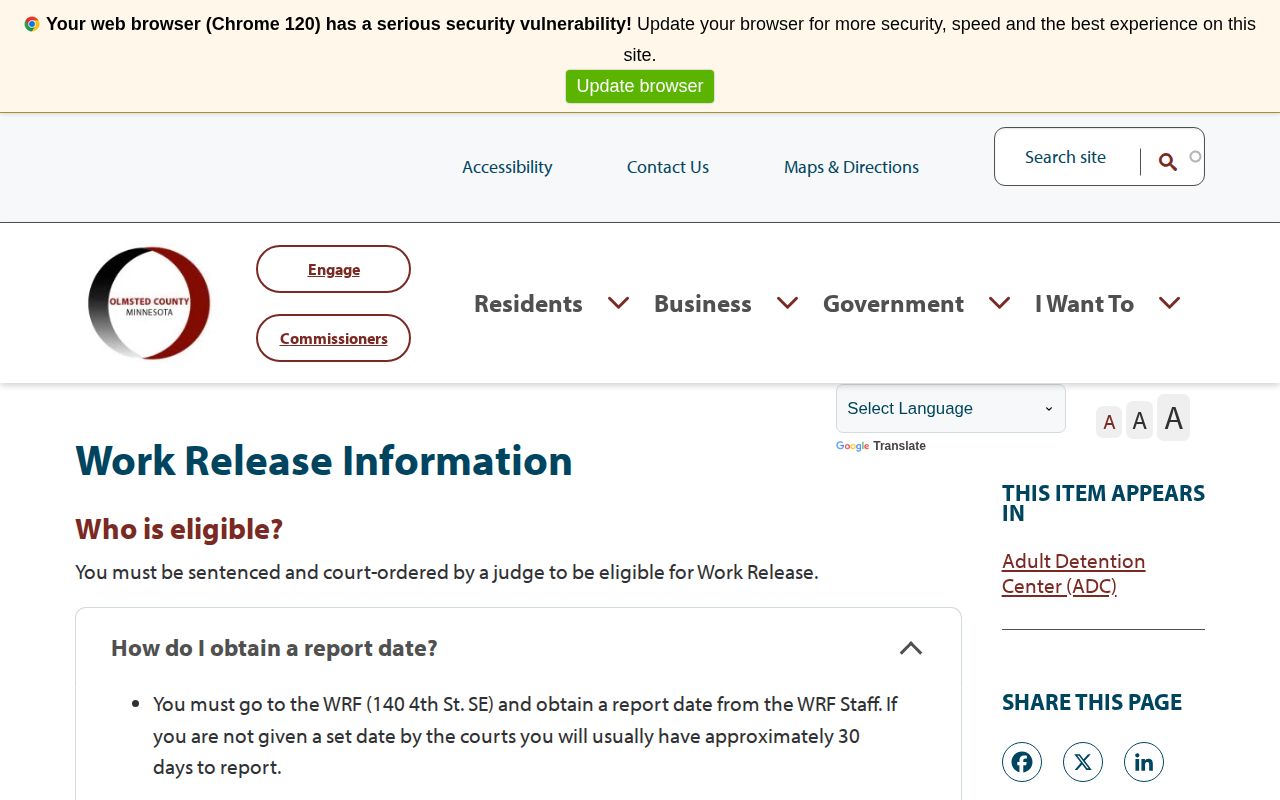
The image explains the program setting, but it does not identify a past participant’s final release. ADC data and the court case remain the proof route.
The Sheriff’s 2024 annual report counted 119 male and 21 female WRF releases. Those total 140 operational release events. They are not a searchable person list and should not be treated as a roster of unique names. The report also does not state that each event represents a different person. Its counts provide context for WRF activity, while a person-specific request is still needed for the legal basis, exact time, and destination.
After a WRF Release
Final release from WRF does not by itself answer whether a person remains under court or corrections control. Probation is community supervision ordered by a court. Supervised release follows a Minnesota prison term. Pretrial monitoring applies before the case is resolved. Those terms are not interchangeable, and WRF participation alone does not prove that any one of them applies after discharge.
Read the sentencing case first. It may show a probation term, later order, or discharge of the case. If the record shows commitment to the Commissioner of Corrections or ADC reports a DOC transfer, use the Minnesota DOC locator. A state profile may show “Under Supervision as of,” the supervising agency, an agent, and an expiration date. That date concerns DOC status, not the time the person left WRF.
- Work release
- Court-approved structured custody with temporary movement for verified work.
- Final release
- The end of the recorded WRF or ADC custody event.
- Transfer
- A move to another custodian rather than release into the community.
- Probation
- Court-ordered supervision in the community, which can continue after local custody ends.
A participant’s route may therefore read: sentence, WRF placement, approved daily movement, final ADC release, and then probation. Keep each step attached to its own date and source. That preserves the difference between taking part in work release and being released from Olmsted County custody.
Note: A court entry explains the sentence, but the Sheriff’s release record supplies the facility event and any receiving agency.