
No Olmsted 72-Hour Release Feed
The Olmsted County Sheriff does not publish an official rolling 72-hour released-person view. There is no distinct three-day URL, release window, release field set, update schedule, or stated retention period. The direct application is for people currently in jail. Filtering its booking dates would create a list of admissions, not departures. A person booked during the past three days may still be held, while someone released in that period may already be gone from the application.
The official Adult Detention Center page is a sound agency starting point, but it does not become a 72-hour release feed merely because it links to custody information. The absence of a name also cannot prove release. Transfers, data timing, aliases, and source scope all need to be checked.
Request Olmsted 72-Hour Releases
A defined records request is the most direct way to ask about an Olmsted County three-day period. Use exact inclusive boundaries and identify Central Time. For example, state the start date and time and the end date and time rather than saying “over the weekend.” Ask for existing public release and transfer entries within those limits. The county must provide public data it maintains, but it does not have to create a new compilation or answer a custom question.
- Choose precise inclusive start and end timestamps in Central Time for the 72-hour interval.
- Use the county Data Practice Request and identify the Sheriff or ADC system likely to hold the data.
- Ask for existing release entries, booking identifiers, date and time, legal basis, and transfer recipient where maintained.
- Request electronic copies as maintained and ask for a cost estimate before material expense.
- If no data are located, ask which system and interval were searched and whether transfers were included.
The county’s request portal explains submission options. Public inspection is free. Copy and retrieval costs can depend on the form and size of the request. A narrow interval and exact fields reduce ambiguity.
Olmsted 72-Hour Release Fields
No public web table exposes these fields as a rolling 72-hour view. Minnesota Statutes section 13.82 instead supplies the public-data basis for asking the originating agency. Transfer fields are crucial because a departure from ADC may lead directly to Minnesota DOC, another county, a federal agency, or another facility. Only a release or transfer record can distinguish those paths with authority.
| Field | Reason to request it |
|---|---|
| Full name | Identifies the adult attached to the maintained event. |
| Booking number | Separates bookings and helps prevent a same-name mismatch. |
| Release date and time | Tests whether the event falls inside the three-day window. |
| Legal basis | States why custody ended as maintained by the agency. |
| Transfer recipient | Shows that ADC custody ended in another agency’s custody. |
A broad request for “everyone released” might seek a compilation the county does not maintain. Phrase the request as existing entries and data fields. For one known person, add date of birth and an approximate booking date. If the county withholds a field, request the statutory classification and a written denial. A court case is a separate record and cannot replace the Sheriff’s physical release timestamp.
Olmsted Weekend Release Windows
A 72-hour interval is useful because it can bridge a weekend, holiday, or multi-day search gap. That does not mean Olmsted County has a special weekend feed. The county publishes no fixed release clock. Its bail instructions show that court-business-hours payment and nonbusiness-hours payment follow different routes. Outside the court window, the ADC circle-drive lobby wall phone is part of the process. Release processing can take time after payment or an order.
Choose the interval around the event being researched, not around an assumed upload cycle. The sourced cadence for the custody application is “updated daily,” with no fixed daily update hour published. If the concern is a Friday evening through Monday evening period, put those exact Central Time boundaries in the request. A wider request can catch processing that crossed midnight, but the maintained timestamp, not the day someone expected release, controls.
Note: A bond order or payment can precede actual departure, and another hold can prevent community release after the court event.
Olmsted Release Data Quirks
The official current-custody product historically showed a booking photograph, photo date, booking date, incarceration reason, detainee status, charges, descriptions, and offense level. It offered no release timestamp or released-person archive. Vocabulary such as “Release Revoked” described the reason for present custody. It cannot be counted as a release during a 72-hour interval.
The archived official interface dated December 8, 2024 preserves that historical field context.
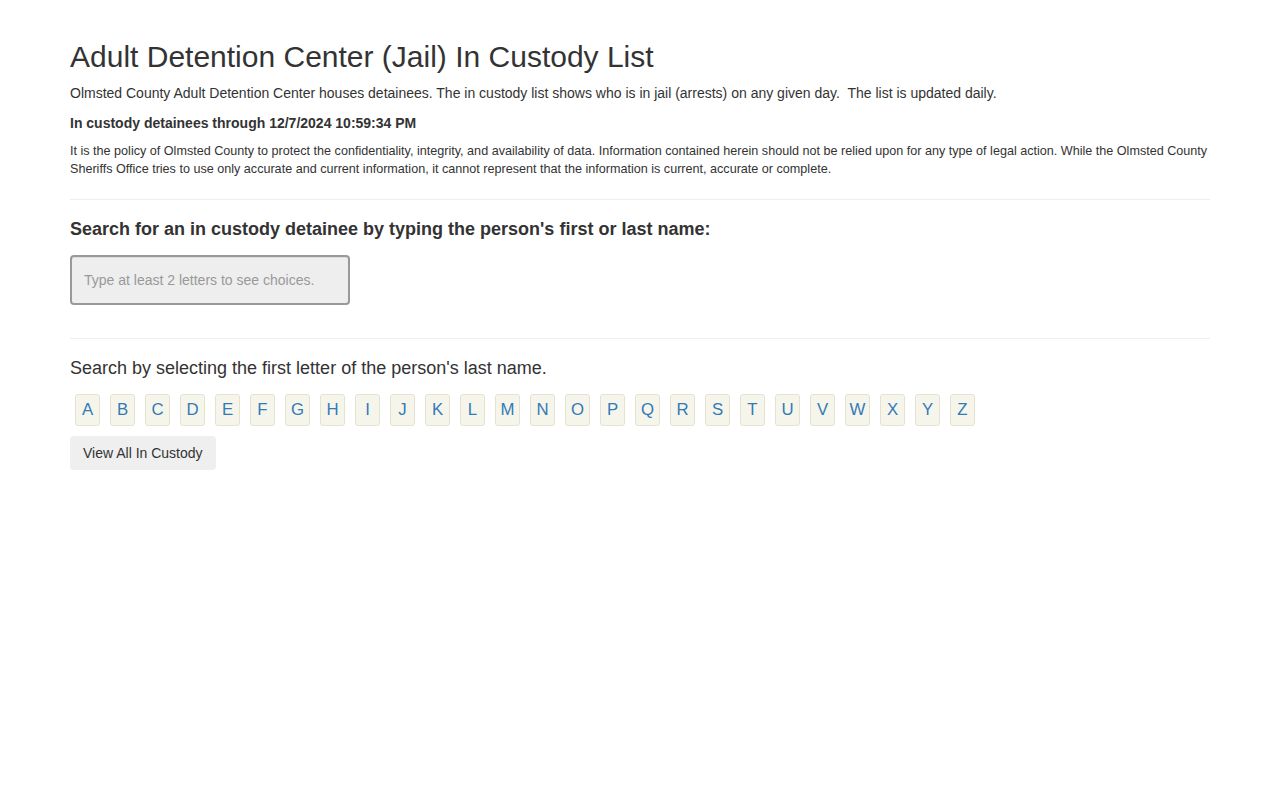
The archived screen is evidence of an earlier current-custody interface, not proof of today’s fields, current availability, or post-release retention. A fresh live view should control current interface claims.
On July 24, 2026, the direct application displayed a temporary-issue message. That outage is now historical. A July 26 live check found the application restored with the heading “Adult Detention Center (Jail) In Custody List,” an updated-daily statement, and in-custody data through July 25, 2026 at 10:59:14 p.m. The restored app is still current custody only and has not become a 72-hour release feed. The official county wrapper, ADC telephone, and request portal remain fallback routes.
Olmsted Released Versus In Custody
A current roster and a release record answer opposite questions. A roster identifies who is held at the time represented by its data. A release record states when and on what legal basis custody ended. If the person is still listed, do not report a release. If the person has dropped off, do not assume freedom in the community. Request transfer fields and check the next likely custodian.
| Question | Best source | Limit |
|---|---|---|
| Is the person at ADC now? | Current-custody application or ADC phone | Not a release history |
| When did ADC custody end? | Sheriff release data | May show transfer, not community release |
| Why did the court permit release? | MCRO case and filed order | Order time may precede processing |
| Did state-prison custody end? | Minnesota DOC profile or record | Does not cover ADC-only cases |
The county jail, state DOC, and BOP each certify only their own custody. Work-release participants also require care: leaving the Work Release Facility for approved work is structured custody, not final discharge. The sentencing case and ADC record establish final completion.
Verify Olmsted Three-Day Releases
After the Sheriff step, use Minnesota Court Records Online for the Olmsted District Court case. Review bond or release entries, disposition, judgment, sentence, and filed documents. MCRO can explain the judicial basis, but it is not the Sheriff’s release log and is not a certified copy. Court Administration supplies certified court records when needed.
Use Minnesota VINELink prospectively for a custody-change or release alert when the responsible agency participates. VINE is free and may offer phone, text, email, or app delivery. A VINE event is agency-fed and can lag; a no-result is not conclusive. For a state-prison case, search the Minnesota DOC locator by name or six-digit offender ID. A profile may say “Under Supervision as of” and identify the supervising agency, while a fully discharged person may no longer appear.
Federal Medical Center Rochester belongs to the Bureau of Prisons, not the Olmsted jail system. A past result in the BOP Inmate Locator with RELEASED status shows only that BOP custody ended. Federal supervision or a new custodian may continue. These sources belong in the chain only when the person’s custody path points to them.
Narrow Olmsted Release Checks
Use the wider window when the event might have occurred across several days. For a same-day event, the Olmsted County Jail Releases: 24 Hours page focuses on direct ADC confirmation, the bail-processing lag, and a one-day data request. For one named person with an uncertain county, state, or federal path, use the Olmsted County released inmate search to select the system before interpreting a missing result.
- Booking date
- The start of a booking record, not proof of release.
- Release date
- The maintained date on which one agency’s custody ended.
- Transfer
- A departure to another custodian rather than the community.
- Disposition
- The court’s resolution of a charge or case, which may not give the ADC exit time.
Keep each date label intact. Photo Date, court disposition date, DOC Anticipated Release Date, Actual Release Date, and sentence Expiration Date answer different questions. Match at least two identity points before joining sources. A name plus booking number, date of birth, court number, DOC ID, or federal register number is safer than a name alone.
Note: Olmsted County has no verified Sheriff release app, routine released-photo stream, online release archive, or stated post-release retention period.