
Olmsted Parole and Probation Compared
Probation is a court-ordered sentence or stayed sentence served under conditions in the community. In Olmsted County, adult probation may be handled by Dodge & Olmsted Community Corrections, commonly called D&O. Supervised release follows the prison part of an ordinary Minnesota determinate sentence. It remains a Minnesota Department of Corrections matter even when the public DOC profile names Olmsted D&O as the local supervising agency.
Parole is narrower. Minnesota created the Supervised Release Board for limited statutory groups effective in 2024, including qualifying life or indeterminate cases, certain juvenile-offense cases, and specified criminal-sexual-conduct cases. Most modern determinate prison sentences do not receive a discretionary parole hearing. Pretrial monitoring is different again: it operates before the case is resolved and does not establish a post-sentence discharge.
| Record type | Who imposes it | Best public verification |
|---|---|---|
| Probation | District court | MCRO case entries, then D&O confirmation |
| Supervised release | Minnesota sentence law and DOC | DOC locator status, agency, agent, and expiration fields |
| Intensive supervised release | DOC supervision placement | Full DOC status and named local agency |
| Parole or board release | Supervised Release Board in eligible cases | Board materials, DOC status, and maintained release data |
| Pretrial supervision | Court before disposition | MCRO and D&O Pretrial Services |
- Discharge
- The end of a sentence or supervision term, not merely the day a person leaves a facility.
- Absconder
- A person alleged to have evaded supervision; a listing is not a new conviction.
- Abatement
- A statutory status that can end active reporting after qualifying compliance while the sentence still has an expiration date.
Verify Olmsted Post-Release Supervision
Start with the court sentence and the custody system. An Olmsted County District Court case can show whether the court ordered probation, stayed execution, imposed local jail time, awarded jail credit, or committed the person to the Commissioner of Corrections. The Minnesota Court Records Online case register explains the judicial action, but it does not replace the supervising agency's current record.
- Search Minnesota Court Records Online and confirm Olmsted venue, case number, identity, judgment, sentence, and later probation entries.
- For a state prison case, search the Minnesota DOC public locator by full name or all six digits of the MNDOC Offender ID.
- Read the entire current-status sentence. Look for “Under Supervision as of,” intensive supervision wording, the supervising agency, agent, and expiration date.
- If the profile names Olmsted D&O, contact that office for clarification. The secure statewide supervision system is not a public lookup.
- For a board-eligible case, compare the Board agenda or approved minutes with DOC current status and actual release data. A hearing or grant alone does not prove physical release.
- When the public locator returns no result after full discharge, request the maintained DOC release and termination record.
The broader Olmsted County released inmate search explains how to pair a sheriff release timestamp with the court disposition when the case never reached state prison.
Note: A no-result is not proof that no Olmsted County probation or release record exists.
Olmsted County Supervision Office
D&O Community Corrections is a joint Dodge and Olmsted county department. Its published service menu includes adult and juvenile probation, intensive supervised release, pretrial services, electronic monitoring, treatment court, and lower-level telephone or web reporting. That range does not mean every person uses every program. It does make D&O the correct local follow-up when an official DOC profile identifies “Olmsted (D&O Community Corrections) (CCA).”
D&O Community Corrections
Official community corrections page
Pretrial Services: 507-328-7222
correctionspretrialservices@olmstedcounty.gov
Use the contact for a defined supervision question, such as whether the agency named on a DOC profile is still responsible for the case. Do not assume Pretrial Services can verify every probation or supervised-release record. For a historical state-prison release, DOC Records Management is the stronger records source.
Olmsted Release Supervision Programs
Olmsted County's local corrections structure spans several stages. Pretrial Services uses an individualized validated assessment and makes recommendations when release is being considered. Probation follows a court disposition. Intensive supervised release follows a distinct correctional placement. Electronic monitoring may be part of a court or supervision plan, yet the equipment itself does not identify which legal status applies.
The distinction matters when a person has left the Adult Detention Center. A roster disappearance may reflect community release, transfer to Minnesota DOC, another county, or a return from work release. D&O's role begins only when the court or DOC has assigned that agency. Read the source record before describing the person as “on parole.” Minnesota's ordinary supervised-release structure should normally be named as supervised release, not parole.
Note: Temporary work-release leave remains structured custody and is not the same as final discharge to supervision.
Olmsted Parole Board Records
The Minnesota DOC Supervised Release Board handles only its statutory caseload. Its public schedule page provides meeting dates, agendas, approved minutes, recordings, and review schedules. Prior materials remain online for a limited period, so annual reports or a records request may be needed for an older decision. No standalone public database was found that searches every Board outcome by name.
Board terms have precise meanings. An initial readiness review can occur before the statutory eligibility point. The Board may assign a projected date, continue a matter with directives, grant release, or deny it. None of those labels should be turned into a door-out date without DOC confirmation. The Board's 2025 report demonstrates why: some grants did not result in entry to the community because consecutive sentences kept people incarcerated.
Olmsted Warrants After Release
Olmsted County maintains a separate active-warrant application. The Minnesota DOC also publishes an active-fugitive search for people alleged to have violated community supervision and evaded authorities. Both are current enforcement sources. Neither is the source for the original release date, sentence discharge, or proof of a new conviction.
The Olmsted active-warrant lookup shows the local search interface:
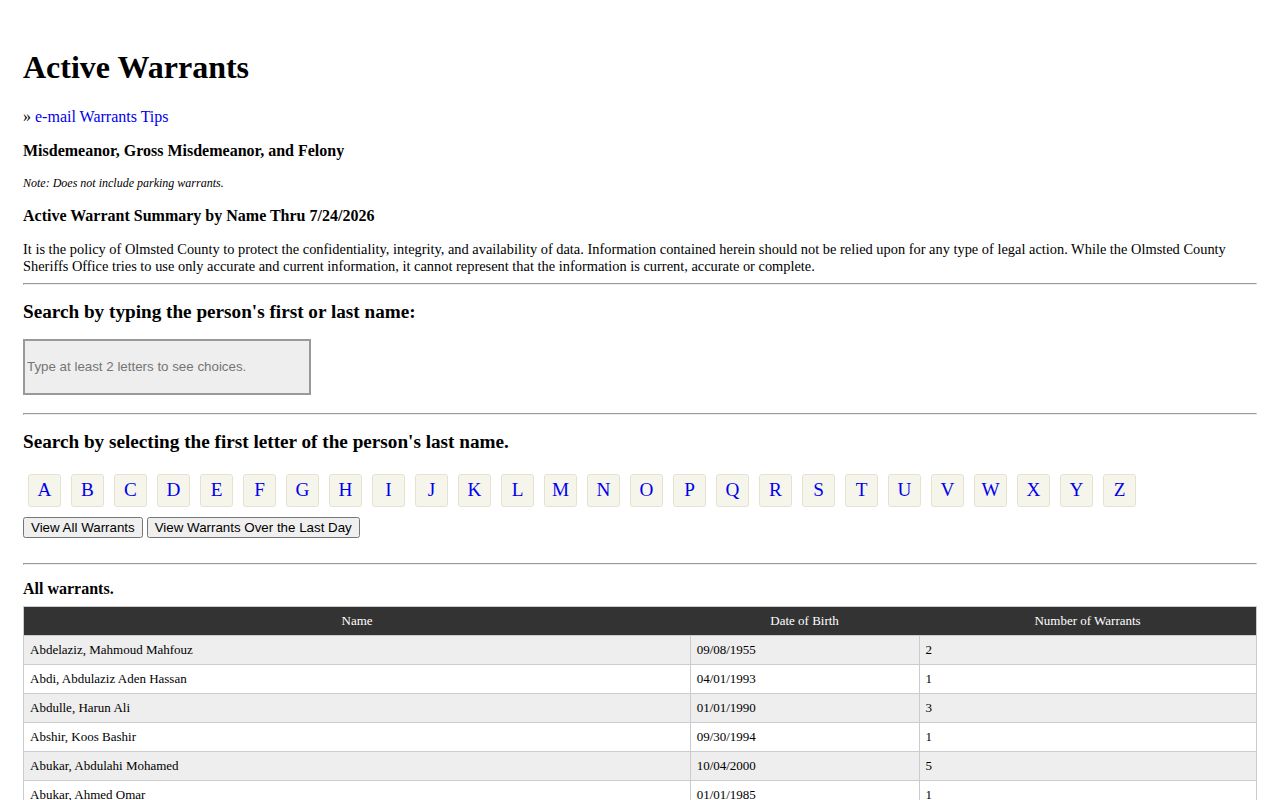
A matching warrant should be checked by identity and followed through the Warrants Unit or the court. It can coexist with a past valid release event.
Olmsted County Warrants Unit
101 Fourth Street SE, Rochester, MN 55904
507-328-6830
warrants@olmstedcounty.gov
Weekdays, 8:00 a.m. to 4:30 p.m.; closed weekends and holidays
Olmsted Supervision Conditions and Violations
Conditions depend on the judgment, DOC release order, and supervision plan. They can address reporting, location, treatment, electronic monitoring, or other case-specific duties. An official DOC Conditions of Release record may also contain release status, address, actual and confinement release dates, termination date, statutory dependence date, and agent contact. Those maintained fields are better evidence than trying to infer terms from a public summary.
An alleged violation can lead to a warrant, fugitive listing, revocation process, or a new jail booking. “Release Revoked” in the Olmsted current-custody vocabulary describes a reason for present custody, not a completed second release. A re-arrest does not erase the earlier release event. Keep the event dates and the agencies separate.
To audit a claimed violation, begin with the document that states the condition. Compare the DOC release order or Olmsted court order with the warrant, revocation entry, and any new ADC booking. A fugitive notice concerns an allegation that the person evaded supervision. A warrant concerns authority to arrest. A court disposition addresses what was later proved or ordered. Treating any one of those records as the whole history can turn an unresolved allegation into an unsupported conclusion.
Olmsted Supervision Discharge Records
Supervision ends through the authority shown in the sentence and corrections record. A DOC profile expiration date is not necessarily the prison-release date. Compliance credit under Minnesota law can move a qualifying person to supervision abatement at a rate set by statute, but abatement ends active reporting under specified conditions rather than rewriting the original release event.
For durable proof, request DOC fields such as Actual Release Date, Confinement Release Date, Release Status, Termination Date, Expiration Date, and public conditions-of-release data. For local probation, pair the Olmsted court register with D&O clarification. This evidence chain distinguishes release from custody, active supervision, and final discharge instead of collapsing all three into one date.
Minnesota compliance credit adds one more status to verify. Under §§244.41 and 244.46, a qualifying person can accrue one month of credit for each two compliant months, and DOC may place the person on supervision abatement. Abatement ends active reporting only under the statutory conditions. It does not change the sentence expiration, prove the original prison-release date, or establish that every Olmsted probation case qualifies. Ask for the maintained DOC status instead of inferring abatement from a lack of routine contact.
Note: Release, supervision expiration, abatement, and sentence discharge are separate events and may carry different dates.