
No Olmsted 24-Hour Release Feed
No official Olmsted County 24-hour released-person feed was identified. The Sheriff’s product is a current-custody list, not a list of people who left custody today. It has no released tab, release-date field, release-reason field, or published period during which a former detainee stays visible. The county also has no verified Sheriff mobile app that supplies recent jail releases. Calling a custody roster a release feed would reverse its meaning.
The official Who Is in Custody page links to the direct detainee application and gives the Adult Detention Center contact route. If a name is present, the person was listed in custody at the time represented by that system. If a name is absent, that absence is only a lead. It does not reveal whether the person was released to the community, transferred, entered state custody, or was missed because of an identity or system issue.
Check Olmsted 24-Hour Releases
A same-day check begins with the narrow question: did this person leave the Olmsted County Adult Detention Center during a stated interval? The Sheriff can address the custody event. Court records can explain the order behind it. VINE can supply a prospective alert when the participating agency reports an event, while the Minnesota DOC and federal systems cover different custodians. None is an official Olmsted recent-release feed.
- Check the official current-custody application. Treat a listed person as in custody, not released, for the status shown.
- Call the ADC at 507-328-6790 for current information and identify the person with more than a name when possible.
- Submit a narrow county Data Practice Request for existing release or transfer data within exact Central Time boundaries.
- Use Minnesota Court Records Online to read the Olmsted criminal case for bond, disposition, sentence, or release-order context.
- Check Minnesota VINELink for a participating-agency event, or the Minnesota DOC locator when a state commitment or DOC hold is involved.
For a broader recent interval, the Olmsted County Jail Releases: 72 Hours page explains how to frame a three-day request without turning current bookings into release entries.
Olmsted 24-Hour Release Fields
Because no online 24-hour feed exists, the right field table is a request inventory, not a claim about a screen. Minnesota Statutes section 13.82, subdivision 2, makes specified adult arrest data public at the originating law-enforcement agency. Clauses covering transfer and release support a focused request for the event data that Olmsted County actually maintains. The county does not have to create a custom report that does not exist.
| Requested field | What it can establish |
|---|---|
| Name and booking identifier | Connects the event to the correct ADC booking. |
| Release date and time | Shows whether departure fell inside the exact 24-hour interval. |
| Legal basis for release | States the maintained basis without guessing from roster removal. |
| Transfer date and time | Distinguishes a transfer event from community release. |
| Receiving agency | Identifies DOC, another county, federal custody, or another recipient when maintained. |
Ask for existing electronic data and state precise inclusive start and end times in Central Time. Include full name, date of birth, approximate booking interval, and booking number if known. The Olmsted County Data Practice Request is the formal route. Public inspection is free, while permitted copy or retrieval charges may apply. Request an estimate before material cost.
Note: Booking Date and Photo Date are not release dates, and a court order time may precede completed ADC processing.
Olmsted Release Roster Limits
The archived official interface said it showed who was in jail on a given day and was updated daily. That cadence does not mean real-time removal. It also does not establish an exact update hour. Historical visible fields included booking photo and photo date, booking date, custody reason, status, charges, charge description, and offense level. Those are current-booking facts. They are not a released-person archive.
The archived official roster from December 8, 2024 documents that older interface. The direct current-custody application displayed a temporary-issue screen when captured on July 24, 2026, but was operational again on July 26.
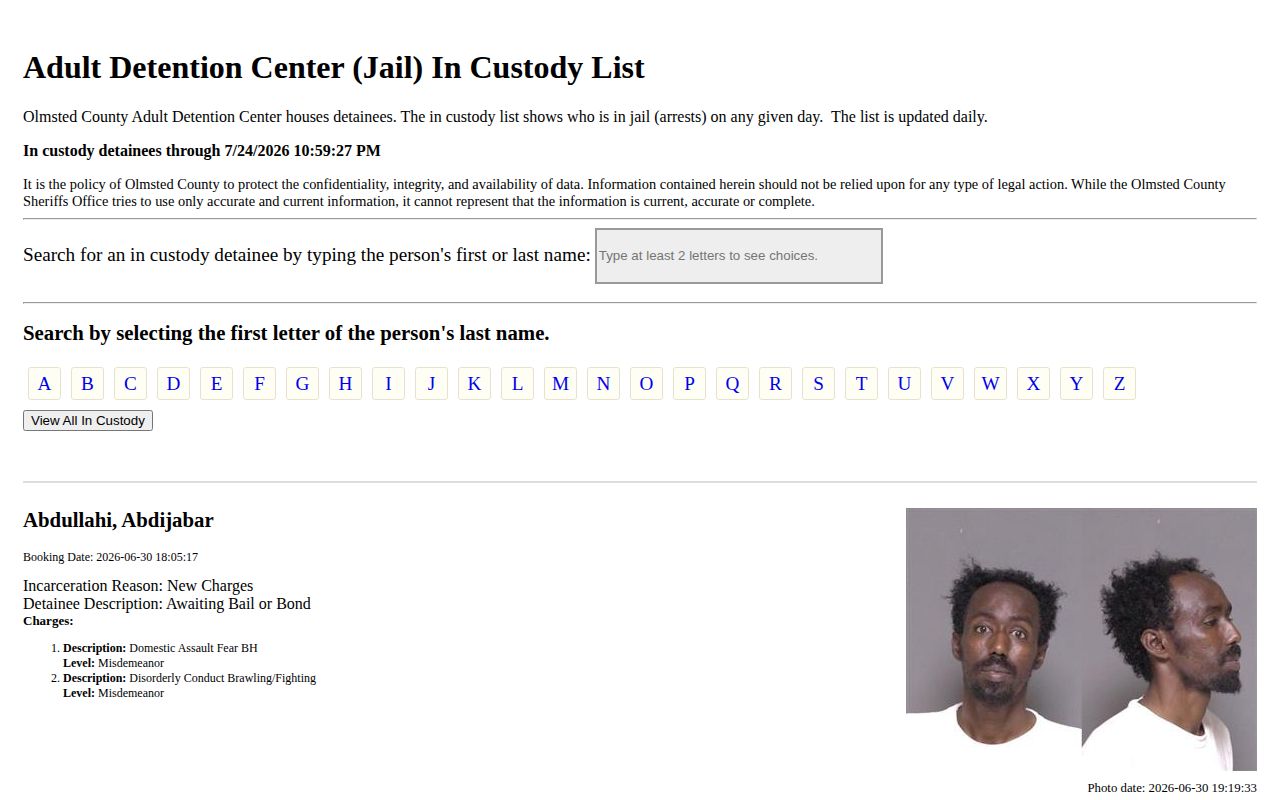
The image records a historical outage, not the current condition. On July 26, the restored page was headed “Adult Detention Center (Jail) In Custody List,” said it was updated daily, and showed in-custody detainees through July 25, 2026 at 10:59:14 p.m. It remains a custody list, not an Olmsted County 24-hour release screen. “Release Revoked” was a reason for present custody in the observed vocabulary, not proof that a completed release occurred.
When Olmsted Jail Releases Occur
Olmsted County publishes no fixed ADC release clock. The official bail process instead describes separate routes based on when payment occurs. During court business hours, bail payment goes through Court Administration, and the receipt must reach ADC before jail processing begins. Outside those hours, including holidays, the payer uses the wall phone in the ADC circle-drive lobby and follows the facility’s accepted-payment instructions.
The county warns that processing can be lengthy. That is why a court receipt, bond entry, or payment time should not be reported as the moment a person walked out. The Sheriff’s maintained release timestamp is the sound record of completed ADC processing. A status call can help on the same day, but a section 13.82 request is the documentation route.
These steps also separate release authority from release completion. Court Administration handles a payment route, the court record shows the order and conditions, and ADC carries out the jail process. Another hold can still affect the final result. When the exact time matters, preserve the court entry for context and ask the Sheriff for the release or transfer event that followed.
The ADC posting-bail page shows the official workflow.
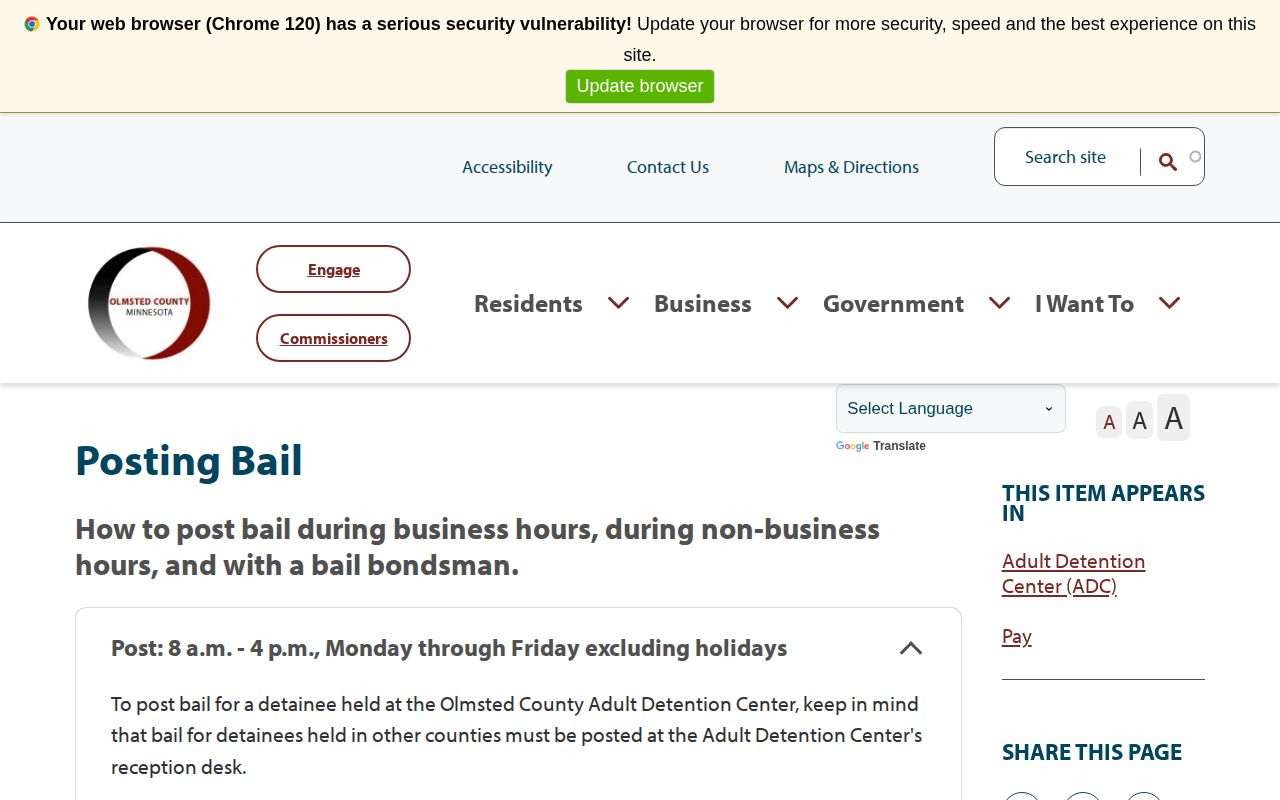
This source explains why same-day release confirmation can lag a court event and why no one should infer an ADC exit time from payment alone.
Getting Home After Olmsted Release
A family member or friend does not need to remain through a long ADC release wait. Olmsted County says the person being released may use the ADC telephone to call for a ride once processing permits. A driver who claims responsibility for the person’s care must pass a breath test showing sobriety. That is a local release condition worth planning for when the exact door-out time is not known.
No official transit-stop rule, taxi rule, rideshare rule, or full property-return procedure was found. Avoid assuming those arrangements exist. Confirm practical pickup details with ADC at the time of release, especially when processing occurs outside ordinary court hours. The known facts are the phone-for-a-ride option and the sober-driver requirement, not a guaranteed transport service.
Olmsted Pretrial Release Decisions
Dodge and Olmsted Community Corrections Pretrial Services adds local context to same-day releases. The program uses a validated assessment and makes individualized recommendations when release is considered. It began in 2019 and received a national county achievement award in 2021. A recommendation does not prove that release occurred. The court controls the order, and ADC records the actual custody event.
The Sheriff’s 2024 annual report recorded 1,458 own-recognizance release events and 492 bail events. Those are operational event counts, not a searchable list of unique released people. They should not be filtered or combined into a made-up daily feed. The official Pretrial Services page explains the program, while the court case and Sheriff release data remain the person-specific evidence.
Verify Olmsted Release by System
A county-jail release, a state-prison release, and a federal release belong to different records systems. For an ordinary ADC booking, pair the Sheriff’s release or transfer data with the Olmsted court case. For a state commitment, search the Minnesota DOC locator. A status such as “Under Supervision as of” can show the prison-to-supervision transition, but a fully discharged person may no longer appear. DOC Records Management is the historical fallback.
For a federal prisoner, the BOP Inmate Locator may show a past release date and RELEASED status. That means only that BOP custody ended. It does not rule out supervision or custody under another authority. Minnesota VINELink is useful for prospective alerts from participating agencies, yet it is not a certified historical ledger. For a named person whose route is unclear, the Olmsted County released inmate search sets out the complete source-by-source path.
- Release
- Departure from one custodian, which may be to the community or another authority.
- Transfer
- Movement into another agency’s custody rather than freedom in the community.
- Discharge
- The end of a sentence or correctional jurisdiction, not merely departure from a jail building.
- Supervision
- Correctional control in the community after prison or under a court order.
Note: Match at least two identity points, such as birth date, booking number, case number, DOC ID, alias, or register number.